
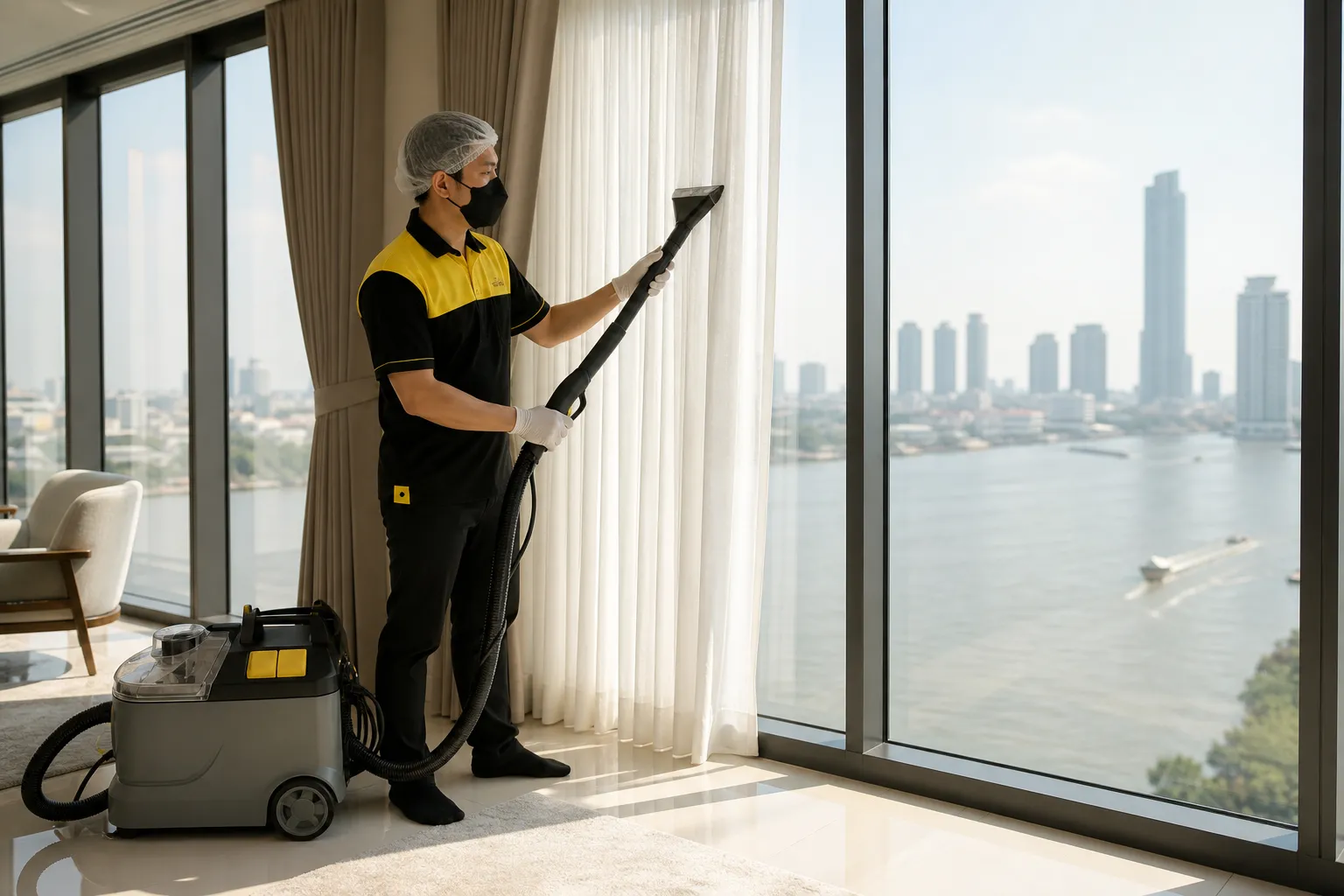
What should you do first when arranging at-home cleaning for blackout and sheer curtains?
When we arrive at the job, we do not immediately spray water or scrub stains. Blackout and sheer curtains react differently to moisture and friction. Blackout curtains may have a coated backing, while sheer fabrics have fine threads that can snag or stretch easily. Curtain cleaning therefore requires checking the fabric type, stain condition and hanging method before starting.
Homeowners often worry that their curtains will shrink, bleed, lose their pleats or lose their shape after cleaning. A trustworthy answer should begin with the method planned for that particular curtain, the areas at risk and the realistic results for the existing stains—not a promise that every stain will disappear without seeing the actual fabric.
Curtains with road dust, cooking odors or hand marks around the edges may only need dust removal and spot cleaning without making the fabric unnecessarily wet. However, if there is a ring-shaped coffee stain, yellow-ring sweat marks or cat urine that has reached the lining, tell the technician from the start. Stain and odor treatment require a different approach from dust removal.
Check the fabric type before arranging curtain cleaning to prevent shrinkage and color bleeding
Before booking a technician, try photographing the front and back of the curtains, along with the care label if it states that they can be machine-washed, hand-washed or must not be washed with water. This information immediately helps rule out risky methods, especially for blackout curtains with foam or a coated backing. A normal-looking face fabric does not mean the backing is still in good condition.
Blackout curtains: beware of the coated backing
Many blackout curtains are made from polyester or fabrics with a light-blocking coating. Long soaking, hot water, hot ironing or vigorous scrubbing of the backing can cause the coating to crack, peel and leave the curtain hanging unevenly. When dealing with coffee marks or hand stains, the technician should test a hidden area first, then adjust the suction and moisture to suit the condition of the curtain.
Sheer and specialty fabrics: start with a gentle touch
Dust is often easy to see on sheer curtains, but their fine threads can snag just as easily. Do not use a stiff brush or scrub in circles on the fabric. Cotton and linen require more allowance for shrinkage and wrinkling than synthetic fabrics. Velvet also requires attention to the nap direction; brushing against it can flatten the nap in patches and may permanently damage the shape.
If the care label says the fabric can be washed with water and it has no fragile coating, you may first try treating small stains yourself. The following steps are suitable for removing dust and fresh stains, not for correcting curtains that have already bled, deeply absorbed cat urine or are made from an unidentified fabric.
- Close the curtains away from strong sunlight, then vacuum from top to bottom using a soft brush attachment, reducing the suction on sheer fabric.
- Blot coffee or water stains with a dry white cloth. Do not rub in circles, as this spreads the stain and can cause the fibers to pill.
- Mix a mild fabric-cleaning solution according to the label. Dab-test it on a seam or the inner hem, then check whether any color transfers onto a white cloth.
- If the color does not bleed, dab the solution onto the stain, working from the edge toward the center. Use a soft cloth to blot; do not pour water over the entire curtain or wring the fabric.
- Rinse the stain according to the care-label instructions, then hang the curtain with the pleats opened and straight in a well-ventilated area. Do not fold or draw it closed while the fabric is still damp.
If the test leaves color on the white cloth, yellow staining spreads or the curtain backing starts to feel sticky, do not continue. Repeated washing will not restore the original shape, and hot ironing to remove wrinkles may melt the coating or leave it shiny.
How professional at-home curtain cleaning is actually carried out
A safe at-home service should begin with an on-site inspection, not one method applied to every home. The technician needs to know whether the curtains are in a bedroom, kitchen or near a cat litter box, how long the stain has been there and which panels are blackout or sheer. Only then can they decide whether to clean them on the rail or remove only the parts that are necessary.
- Check the fiber type, care label, coated backing, hooks and fabric weight to assess areas that may shrink, stretch or bleed.
- Vacuum dry dust first to reduce loose particles, then separate blackout and sheer fabrics. Do not use the same suction power or brush for both.
- Test the color and cleaning solution in a hidden area and leave it for 10-15 minutes before moving on to visible sections.
- Treat specific stains such as coffee, yellow sweat rings or cat urine odors while controlling moisture and preventing the fabric from becoming so wet that water runs down the wall.
- Inspect the fabric surface, color, marks, odor and how well the pleats recover before handing the curtains back. Also explain how to ventilate the room and operate the curtains after the service.
At Hurryclean, on-site results are tested based on customer satisfaction. What should be checked is not only whether the fabric looks cleaner, but also its color, marks, odor and pleat shape. If an original mark cannot be removed, the technician should explain this honestly rather than masking it with perfume or repeatedly wetting the fabric.
Coffee stains, yellow rings and cat urine require different treatment
Fresh coffee stains should be blotted from the outside toward the center, not rubbed hard, or the ring will spread—especially on light-colored sheer curtains. Yellow sweat rings often appear along the edges or in areas touched frequently. They must be carefully separated from the changed color rather than treated by pouring bleach over the fabric and hoping the entire curtain becomes evenly white.
With cat urine, tell the technician the stain's location and depth, as the odor may be inside the fibers or on the back of the curtain. Spraying perfume over it creates two layers of odor, and if only the surface is treated, the smell may return when the air is humid. Old stains that have changed the color should therefore be tested by a technician first. No one should promise that every area will look brand new.
What should you ask before calling a curtain-cleaning technician?
A professional team is not judged by advertising claims alone. Ask who checks the fabric type, what method will be used on the curtain backing, whether the work will be done on the rail or after removal, and how pre-existing damage will be recorded. If there are rework or service-guarantee terms, ask whether they cover existing stains, color bleeding or damage that was already present.
There is no fixed number of hours for this work. Cleaning time and drying time are separate periods. Sheer curtains dry more easily than thick blackout curtains, but a closed room or humid air can slow the process. The technician should explain both the working time and how long you should avoid drawing or folding the curtains before starting.
You can also ask directly about safety for children and pets: What products will be used? Does the area need to be kept clear until the fabric is dry? Should you use a fan or air conditioner, and how? After the service, children and pets should not play with fabric that is still damp, even if the smell has faded.
The actual price of curtain cleaning depends on the size, fabric type, coating and condition. Ask the technician to assess the job on-site and provide a clear estimate before booking. For Hurryclean, the listed selling point is that heavy stains, musty odors and urine odors incur no additional charge.
Book Hurryclean for at-home curtain cleaning and provide details of the actual fabric
Before contacting us, photograph the front and back of both blackout and sheer curtains, the care label and each stained area in close-up. Tell us whether it is a coffee stain, a yellow sweat ring, a musty odor or cat urine. If you live in a condominium, also tell us the hours when building management permits work. This information helps us discuss the right method and provide a more accurate estimate.
Hurryclean provides at-home cleaning for blackout and sheer curtains in Bangkok and surrounding provinces, including Watthana, Chatuchak, Huai Khwang, Khlong Toei, Pathum Wan and Ratchathewi. These are only examples of areas where we frequently work. Our review page shows a Google Review rating of 5.0 from more than 1,700 reviews, with praise for polite technicians, clear explanations and transparent pricing.
If you are unsure whether the curtains should be removed or cleaned on the rail, do not soak them or remove the hooks yourself. Send photos of the actual fabric and care label via LINE @hurryclean so the technician can assess the right method for blackout or sheer curtains, then book an at-home service.